 Boracay Tours Package
Boracay Paraw Sailing: Prices, Timing and What You Actually Get
Boracay paraw sailing is the island's oldest boat trip and still its cheapest hour on the water. A paraw is a traditional Filipino double-outrigger sailboat, a wooden hull braced by two bamboo outriggers joined by a flat net where passengers sit, moved entirely by a triangular sail with no engine at all. The same boats sell at two very different prices: an operator ladder that runs from about ₱3,700 for one passenger to ₱7,700 for ten, booked through a platform, and a negotiated rate on the sand of roughly ₱500 an hour with no booking and no receipt. Neither price buys an itinerary. A paraw visits nothing, it's a sail, not a tour, and what follows is what that sail is actually like, when it runs, and which of the two prices is the honest one for your evening.
Quick answer
Boracay paraw sailing costs about ₱3,700 to ₱7,700 booked through an operator, scaling with how many passengers join, or roughly ₱500 an hour negotiated directly with a boatman on the sand, the same boats, two different markets. Either way, a paraw sail visits nothing: it's thirty minutes to an hour on the water, usually timed around sunset, with no stops and no itinerary attached.
Key takeaways
- Operator pricing runs a ladder: about ₱3,700 for one, ₱4,700 for four, up to ₱7,700 for ten passengers
- The same boat, booked on the beach instead, runs about ₱500 an hour, no booking, no receipt, no cancellation window
- Sunset departures leave around 5:00 to 5:30 PM; daytime sails run 9:00 AM to 3:30 PM
- A paraw is a sail, not a day trip, for an itinerary with stops and lunch. See the six Boracay packages compared or the private island-hopping boat
- Life jackets are worn throughout and crews reschedule when the wind is too light or too strong
- Wind direction decides whether the sail even happens. See the best time to visit for the seasonal pattern
What a Paraw Is: the Boat, the Sail and Why It Has No Engine
A design that predates the motor
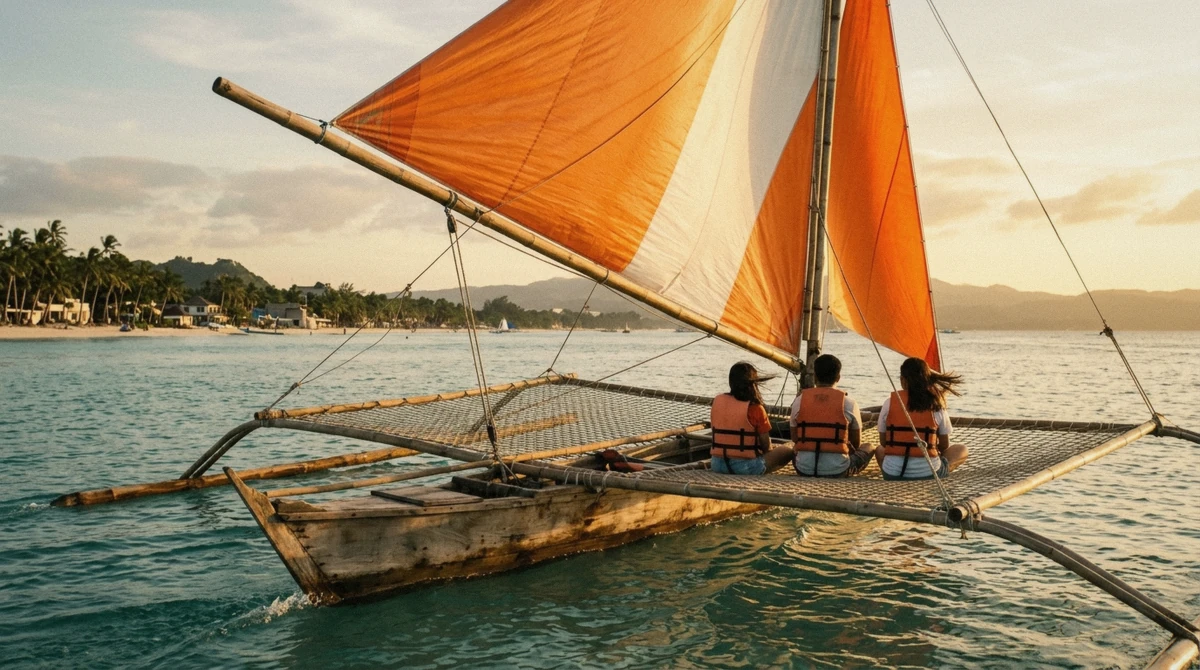
A paraw is a double-outrigger sailboat: a narrow wooden hull with two bamboo outriggers extending out on either side, connected by a flat woven net that passengers sit on rather than a covered cabin. A single triangular sail, often the bright orange or striped canvas seen in every Boracay sunset photograph, is the only means of propulsion, there's no engine on board at all. The outrigger design is what makes the boat stable enough to carry passengers on open water despite its narrow hull and total reliance on wind.
It's a traditional Filipino boat type used for fishing and inter-island transport long before it became a tourist activity, and the boats working the Boracay shoreline today are built the same way, scaled and finished for passengers rather than cargo. A typical passenger paraw seats somewhere between two and six people on the net platform, with the boatman working the sail and tiller from the stern. There's no assigned seating in any formal sense, passengers arrange themselves across the net, and the boatman calls out when to shift weight as the boat comes about or catches a stronger gust. It's a hands-on, physically present kind of sailing rather than something you sit back and watch happen.
Price: the Operator Ladder Versus the Beach Rate
The single most useful table on this page, because the two prices for the same boat aren't close.
Two markets, one boat
Book through a platform or an operator's own listing and you're paying into a fixed price ladder that scales by passenger count. Walk onto White Beach and flag down a boatman directly, and you're negotiating a different number entirely, lower, but with none of the structure a booking gives you.
| Route | Typical price | What it includes |
|---|---|---|
| Operator, 1 passenger | About ₱3,700 | Life jacket, fixed booking, English-speaking crew |
| Operator, 2 passengers | About ₱4,000 | Same, split two ways |
| Operator, 4 passengers | About ₱4,700 | Same, split four ways |
| Operator, 10 passengers | About ₱7,700 | ₱500 per extra passenger beyond the base tiers |
| Negotiated on the sand | About ₱500 an hour | The boat and the boatman, no receipt, no fixed sail time, no cancellation policy |
Why the gap exists
The platform price buys a confirmed booking, a life jacket, and a crew used to dealing with tourists in English, plus a hotel pickup in most listings. The ₱500-an-hour beach rate buys the same boat and the same water, minus the paperwork. For a traveller who wants a guaranteed slot at sunset and no negotiation, the operator price is the fair trade.
For someone flexible on timing who's comfortable haggling in person, the beach rate is the better deal by a wide margin, often less than a fifth of the per-person operator cost for a small group.
Sunset Sail or Daytime Sail: Timings and What Changes
Two formats, different lengths
Operators sell two distinct products: a 30-minute sunset ride and a one-hour daytime sail. The sunset version is timed to put you on the water as the light changes, and once hotel pickup and drop-off are added, the whole outing runs about 1.5 to 2 hours door to door even though the sail itself is half that. Sunset departures leave around 5:00 to 5:30 PM depending on the month and where the sun is setting that time of year.
Daytime sails run any time between 9:00 AM and 3:30 PM, and they're the calmer, more photography-neutral option, good for people who want the experience without competing for the same stretch of water as every other sunset boat.
What the Sail Is Actually Like, and Who Should Skip It
Quiet, a little wet, no itinerary
There's no engine noise, just the sound of water against the hull and the sail catching wind. Life jackets are provided and worn throughout the sail, and the double-outrigger design keeps the boat stable even when it's heeling into a stronger gust, it's a different feeling from a motorboat, closer to a rocking than a bounce. What a paraw doesn't do is stop anywhere. This is a sail along the coastline in front of White Beach, not a route to a beach, a cave or a snorkel site.
Anyone expecting an island-hopping-style outing with stops at Puka Shell Beach and the paid islands will be disappointed; anyone who wants thirty minutes of quiet water and a changing sky gets exactly that. Skip it if seasickness on a boat with no fixed cabin and some rocking motion is a concern, or if what you actually want is somewhere to swim or snorkel, a paraw puts you on the water, not in it. It's also not a private, quiet experience in the way a photo might suggest.
Dozens of other paraw boats are usually out at the same time during the sunset hour, all sailing roughly the same stretch of water in front of the hotel strip, so anyone picturing a solitary boat alone against the horizon should expect company. That said, the boats spread out enough once underway that it rarely feels crowded once you're on the water rather than watching from the beach.

Most paraw bookings, whether through a desk or negotiated directly, start with a conversation somewhere along this stretch.
Booking on the Sand: the Three Questions to Ask
What actually separates a fair price from an inflated one
Three questions settle most negotiations on the beach. How long is the sail, thirty minutes or a full hour, since the ₱500-an-hour rate should scale with time, not stay flat regardless. Is the price per boat or per person, a paraw seats several people, and a quoted price that's actually per head can multiply fast for a group. And is a life jacket included, it should be, at no extra charge, on any boat carrying passengers.
A boatman who answers all three plainly and doesn't push back is quoting close to the going rate. Vague answers or a refusal to confirm the sail length before you're already on the water are the signs to walk toward a different boat instead. The stretch of sand in front of Stations 1 to 3 has dozens of paraw boats pulled up at any given time, so there's rarely a shortage of boatmen willing to negotiate, especially outside the peak sunset hour.
Arriving thirty or forty minutes before the light starts to change gives you time to compare two or three offers before committing, rather than settling for the first price quoted when the good light is already running out.
Paraw Versus the Other Boat Days on This Island
Four ways to spend time on Boracay's water
A paraw sail sits at one end of the spectrum, cheapest, shortest, and the only one with no stops at all. Compared against a seat on a group island-hopping boat, a private charter, or a dedicated sunset cruise, the differences are mostly about what you're actually buying: a sail, or a day.
| Option | Typical cost | Duration | Stops |
|---|---|---|---|
| Paraw, operator booking | ₱3,700–₱7,700 (scales by passengers) | 30 min to 1 hour | None, a sail only |
| Paraw, negotiated on sand | About ₱500/hour | As agreed with the boatman | None, a sail only |
| Group island-hopping seat | About ₱900–₱1,900 per person | About 5 hours | Beach stop, snorkelling, sometimes Crystal Cove or Magic Island |
| Private island-hopping boat | $100.10 for the whole group | About 4 hours | Beach stop, two snorkel sites, lunch at Tambisaan, both island gate fees included |
| Sunset cruise | From about $16 | 1 to 2 hours | None, a scenic cruise, sometimes with food and drinks |
Where a paraw fits in a trip
It works best as an add-on to a day that's already covered the boat-with-stops box, not as a replacement for one. Pair a morning on the private island-hopping boat, snorkelling, a beach stop, lunch, with a paraw sail that evening, and the two together cover both what an island-hopping day is for and what a sunset sail is for, without either one trying to do the other's job.
Budget travellers sometimes ask whether a paraw sail can substitute for a proper boat day to save money. It can't, not in any way that holds up: the private boat and even a basic group island-hopping seat put you somewhere new, in the water, with lunch or snacks included. A paraw is an evening activity layered on top of a day that's already happened, priced and timed accordingly.
Season and Wind: When a Paraw Doesn't Sail
The boat needs wind, but not too much of it
During Amihan, November to May, White Beach stays calm and a sunset sail is close to a glide, steady wind, flat water, minimal rocking. During Habagat, June to October, afternoon squalls build over the island and cancel more paraw sails than any other single factor. The full seasonal breakdown is here, but the short version for this activity specifically: crews reschedule or cancel outright when the wind runs too light to move the boat at all, or too strong to sail it safely, and a paraw is more weather-sensitive than a motorised boat because it has no engine to fall back on if the wind dies mid-sail.
What to Bring on a Boat With No Cabin
There's no shade and no dry storage
A paraw has an open net platform, no roof, no cabin and nowhere fully dry to stash a phone.
- A dry bag or a sealed plastic bag for your phone and wallet
- Sunglasses, the glare off the water is direct with no shade to duck under
- A light layer for the sunset sail, since the breeze picks up once you're moving
- Cash if you're negotiating on the sand rather than booking ahead
- Reef-safe sunscreen if you're going on a daytime sail
- A change of clothes back at the room, spray off the outriggers reaches the net platform on a breezier run
Boracay Paraw Sailing: the Questions People Ask
How much does paraw sailing cost in Boracay?
Through an operator, the ladder runs about ₱3,700 for one passenger up to ₱7,700 for ten. Negotiated directly with a boatman on the sand, the same boat runs closer to ₱500 an hour, a much lower price, with no booking or cancellation protection attached.
How long does a paraw sail last?
Operators sell two formats: a 30-minute sunset ride and a one-hour daytime sail. With hotel pickup and drop-off added, the sunset version takes about 1.5 to 2 hours door to door even though the time on the water is half of that.
What time is sunset paraw sailing in Boracay?
Departures generally leave around 5:00 to 5:30 PM depending on the month, timed to put you on the water as the light changes. Daytime sails run separately, any time between 9:00 AM and 3:30 PM.
Does a paraw stop at any beaches or snorkel spots?
No. A paraw sail visits nothing, it's a sail along the coastline in front of White Beach, not an itinerary. For stops, snorkelling and a beach, the private island-hopping boat is the comparison to look at instead.
Is it safe to negotiate a paraw sail directly on the beach instead of booking online?
It's common practice and generally fine, provided a life jacket is confirmed before you board and the sail length and price are agreed up front. What you give up compared with an operator booking is a fixed schedule, a receipt and any recourse if the boatman doesn't show.
Can a paraw sail be cancelled by the weather?
Yes. Crews reschedule or cancel when the wind is too light to move the boat or too strong to sail it safely. This happens more often during Habagat, June to October, when afternoon squalls build quickly, than during the calmer Amihan months from November to May.
Do I need to know how to sail to go on a paraw?
No. A crew member handles the sail and the tiller throughout; passengers sit on the net platform and don't need any sailing experience.
Is a paraw sail good for young children?
It can work for children old enough to sit still on an open net platform and keep a life jacket on for the duration, but there's no cabin, no rail and some rocking motion, so it's a judgment call for parents of toddlers rather than a straightforward yes.
Is parasailing in Boracay worth it, and is it the same thing as paraw sailing?
They are different products that sound alike. Parasailing is a canopy towed behind a speedboat, sold along White Beach at about $49 for fifteen minutes, and it is worth it if you want height and photographs. Paraw sailing is the traditional double-outrigger sailboat with no engine, and it is worth it for the sail itself. Neither visits anything, which is what separates both from a boat day with stops.
The honest way to think about paraw sailing is as a sail bought at two different prices for the same experience, not as a tour with an itinerary hiding inside it. Book ahead through an operator if a fixed sunset slot matters more than the cost; negotiate on the sand if flexibility and a lower price matter more than a confirmed booking. Either way, plan the rest of the day's stops separately.